
Summary: Many leaders approach AI looking for answers about what comes next. The real value sits elsewhere. AI helps teams think more clearly, examine assumptions, and work through decisions with greater rigor before committing. This article explains how experienced leaders use AI to strengthen judgment, not replace it.
Key Highlights
-
Prediction is the wrong mental model. AI does not reveal the future, and treating it that way creates false confidence.
-
Better decisions come from better exploration of assumptions and scenarios. AI helps leaders examine more possibilities before they commit.
-
Assumptions often carry the real risk in growth decisions. AI can surface the logic behind a plan and help teams test it more thoroughly.
-
Scenario thinking becomes faster and more practical to apply. What once took days or weeks can now happen in a structured working session.
-
Leadership judgment still decides the outcome. AI improves the thinking around the decision. Leaders still own the decision and its outcome.
Every few weeks, another story appears about AI predicting what customers will do, where markets are heading, or which disruption is coming next.
It sounds appealing, but it sets the wrong expectation for how decisions actually work.
AI is not a crystal ball. It cannot tell you what will happen next. What it can do is help leadership teams work through uncertainty with more clarity and speed, test the underlying logic more thoroughly, and consider more options before committing to a decision.
At WSI, this comes up often in conversations with business leaders facing decisions that are harder to make than they were a few years ago. Across our global consulting network, built on more than 30 years of digital experience, the same tension shows up repeatedly. Leaders are not looking for perfect predictions. They are looking for a better way to evaluate decisions when market conditions, customer behavior, and internal priorities keep changing.
This is where AI becomes useful. It strengthens how leadership evaluates a decision before committing to a direction.
Why Prediction Is The Wrong Starting Point
When leaders expect AI to predict outcomes, they often make one of two mistakes. Some trust the output too much. Others lose trust when conditions change.
Both reactions come from using the wrong frame.
Most business decisions are made while conditions are still changing. Prices move, customers behave differently, competitors respond, and internal constraints show up mid-execution. What matters is not whether AI can produce an answer on demand, but whether leadership has tested the decision thoroughly enough before moving. AI helps sort information, compare scenarios, and challenge assumptions before a decision is made.
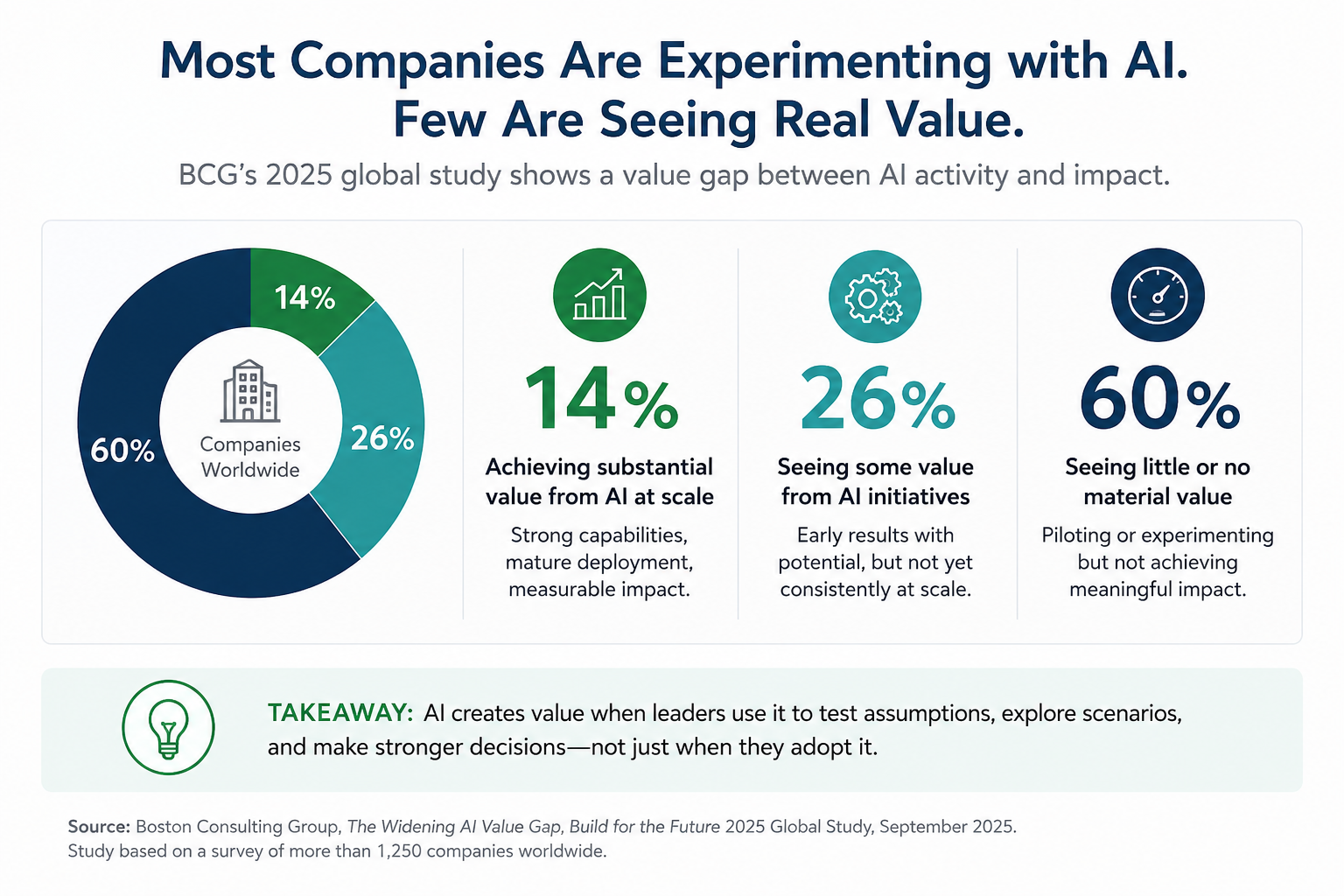
In most cases, the risk sits in assumptions that were never fully tested. The same pattern is starting to show up more broadly as AI adoption increases. A 2025 study by Boston Consulting Group found that only 26% of companies are seeing tangible value from AI at scale, despite widespread experimentation.
Many businesses are using AI to produce more output. Fewer are using it to improve how decisions are made.
How AI Helps Leaders Think Through Decisions
In many leadership discussions, the earliest version of a plan shapes the conversation too quickly.
Once one option takes hold, teams often start reacting to it rather than examining whether its assumptions are strong enough.
AI helps slow that down in a useful way.
For example, consider a leadership team evaluating a new market entry.
One scenario assumes steady customer demand and controlled hiring costs. Another assumes slower adoption, margin pressure, and delayed breakeven. A third assumes earlier or more aggressive competitor entry.
The objective is not to select the most optimistic outcome. It is to understand which variables carry the most weight and where the plan is exposed.
The same approach applies to pricing decisions, capacity planning, and capital investment. Small changes in assumptions can materially affect margin, cash flow, and time to return.
In many cases, those trade-offs directly affect margin, capacity, and how quickly the business can scale.
Assumptions Are Usually Where The Risk Sits
Most business decisions depend on assumptions.
A growth plan depends on demand holding up. A hiring plan depends on the business being able to carry more cost. A product launch depends on timing, resources, and market response being strong enough to make the investment worthwhile.
Teams can use AI to identify where a plan relies too heavily on a few uncertain factors. It can show which inputs carry the most weight and how the decision changes when one of them shifts. That gives leaders a chance to question the logic behind the plan before the business is locked in.
The value is not in removing uncertainty. It is in making the weak points visible early enough for leaders to respond.
Why Human Judgment Still Matters Most
Leadership judgment determines how far analysis should go and when a decision needs to be made.
AI can expand the range of scenarios considered and highlight where risk concentrates. It does not determine which risks are acceptable or how they align with the company’s position, timing, or appetite for growth.
Decisions involving market entry, restructuring, or investment carry internal context that data cannot fully represent. Leadership teams weigh relationships, operating constraints, and long-term positioning alongside the analysis.
The role of AI is to strengthen the inputs into that judgment. The responsibility for the decision remains unchanged.
A More Practical Way To Start
For most businesses, the starting point is not a tool. It is a decision already in motion.
This could include:
-
A pricing adjustment affecting margin
-
A hiring plan tied to growth targets
-
A market expansion decision
-
A capital investment with uncertain return
The focus is to improve how that decision is evaluated.
At WSI, we work with leadership teams to structure this process.
That includes:
-
Framing the decision in business terms, not technical outputs
-
Identifying which assumptions carry the most financial and operational impact
-
Testing scenarios that reflect real operating conditions
-
Interpreting results in the context of the business, not in isolation
The outcome is not a model. It is a clearer decision with fewer unknowns.
If your leadership team is making larger decisions with tighter margins for error, it is worth strengthening how those decisions are evaluated.
WSI works with business leaders to apply AI where it improves decision clarity, not operational complexity. The focus stays on testing assumptions, understanding trade-offs, and making decisions that hold up under real operating conditions.
A focused discussion can help you identify where decisions can be tested more rigorously and where AI can add immediate value.